INTRODUCTION
This paper attempts to explain the postal and philatelic terms associated with the word franking. Some people will find at least some of the terms "exaggerated" or even "useless". However, on closer examination, especially on careful consideration, one will inevitably find that these terms - used correctly - can be very informative and thus have their justification in philatelic terminology. Whether hunters or pigeon fanciers, sportsmen of all disciplines or amateur radio operators, whether in the professional field or in the field of hobbies, everywhere there are special technical terms, i.e. a terminology of their own, which is often jokingly referred to as "technical jargon". But what is found in all fields should not be foreign in philately. If in a technical language word inventions and word formations (technical terms) make it possible to describe a thing or a process precisely without needing a (often long) description or paraphrase, then this "technical jargon" is justified. But please remember that a language, even a technical language, can only be used if it is understood and mastered by the group of people in question. After this short excursion into the field of technical language, back to philately, back to frankings.
Definition
If we want to talk about frankings, it is necessary first to clarify what is meant by franking.
"Payment of the carriage charge at the post office" - so Brockhaus says. "Frankaturen are the stamps affixed to a postal item and representing the amount of postage, whereby it is irrelevant whether one or more stamps are used or necessary" so writes Hager in his Grossen Lexikon der Philatelie. "Franking is the amount of postage stamps that must be spent to frank a postal item according to the valid postal tariff" - this is how Arnau interprets it in his Handbuch der Philatelie. These statements are comprehensible to the reader and essentially get to the heart of the matter. However, I would like to offer my own interpretation of the term "franking". It reads as follows: "Frankatur" is the amount to be paid in postage stamps or in cash for a postal item and a postal route according to the valid postal rate regulations and to be indicated on the item. This statement is, in my opinion, somewhat more precise and more applicable to the overall treatment of the subject. But, is that really all that can be said about frankings? In all four cases, the definition refers to proof of having paid the fees demanded by a postal administration for the transport of a postal item. Is that enough for the philatelist who strives to describe a thing accurately and, above all, to designate it correctly? It will probably not be enough. For this, the subject matter must be worked through and the knowledge of frankings must be deepened.
When working on the term "franking" or "frankaturen", one cannot avoid the terms "postage", "franco", "taxe" and "fees". The terms become blurred and often cannot be separated from each other. However, if you want to make the subject of "franking" comprehensible, you first have to deal with these terms.
Postage
In earlier times, postage was the general term for all types of postal charges. In the vernacular, this is still the case today. Later, postage was understood to mean the fee to be collected from the recipient (postage), and this is how the term is still interpreted today. In connection with the word "postage" is postage-free, which should actually be correctly called "fee-free". Individuals, public authorities, state and private institutions etc. were and are granted exemption from charges under certain conditions, either temporarily or permanently. These postal items must be marked accordingly to avoid unjustified postage (surcharge) being levied on the recipient.
Franco
Franco is the opposite of postage. In this case, the recipient does not have to pay any fees. The sender pays the amount specified in the scale of charges in cash or by means of a postage stamp. Franco is therefore to be translated as "free" or "franked" or, as it was also called in earlier times, "franked".
Taxe
The word "taxe" is an old collective term for postage and franco that is still used in many countries today; in a way, it is an umbrella term for prepaid or subsequently collected postal charges.
One speaks of a "tacked-on" item when the sender has not paid the prescribed fee or has not paid it in full and the post office has noted the necessary additional charges (postage) on the item. Very often the postmark T was and still is used by postal administrations for this purpose. It would be wrong to take this as an argument for using the term exclusively for postage recovery.
Fee
A fee is a charge levied in return for the use of a public facility. The Post is a public institution. Its fee rates are regulated in a schedule of fees, which is amended from time to time and adapted to economic conditions. This all-encompassing term "fee" is applied equally to the terms postage, franco, taxe and franking. It is further proof of how closely intertwined these terms are.
But back to franking. What is meant by franking has already been said. Not all charges levied by the post office for a service are frankings; not even when they are provided with postage stamps. This will be discussed later.
For the philatelist, the concrete determination of a franking is of importance. Depending on the theme and structure of a collection, such pieces must be precisely integrated into the chronological sequence of the collection. This can only be done if the piece is clearly classified.
This brings us to the first and most important prerequisite. A piece can only be clearly classified if it is classifiable. Letter parts and pieces are not (or only to a limited extent) suitable material for franking. One does not know what was torn off or cut off from the pieces and usually cannot reconstruct it. Only complete pieces in which all postage stamps used, place of dispatch, place of receipt, postmarks of all kinds, routing marks and all other postal markings are recognisable and unaffected guarantee a perfect classification.
Another basic requirement is to know the multitude of frankings and their philatelically correct designation. There are always uncertainties and incorrect designations that could be avoided. This is certainly also due to the fact that one cannot simply write the individual franking designations one below the other and assign the pieces to be examined to one of these designations. In principle, several franking terms are applicable to each item. It depends on the point of view from which one looks at the piece in order to determine the assignment possibilities.
Example:
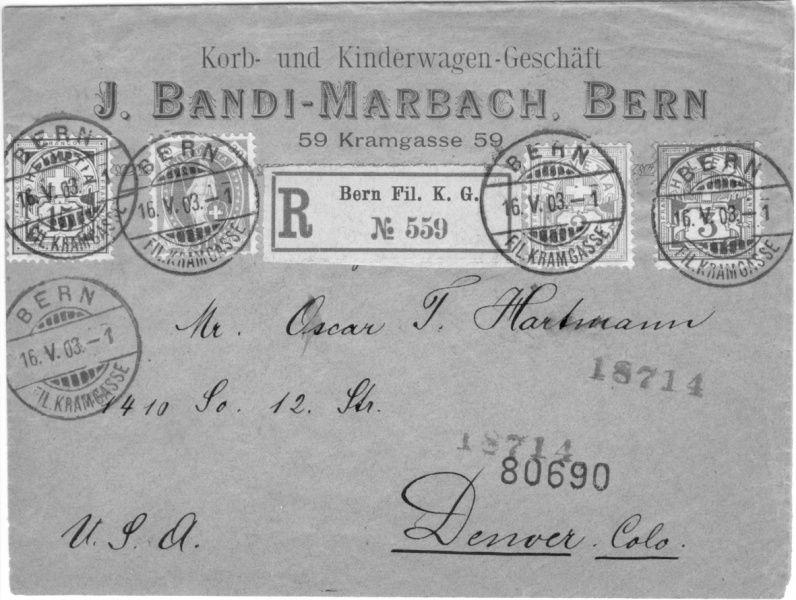
A registered letter is franked with four stamps of the same issue but with different nominal values and addressed to a recipient in France. These pieces are
a registered franking
a coloured franking
a foreign franking and
a multi-colour franking.
The philatelist who has classified such a piece according to all aspects can now choose under which designation and in which place in his collection he can best show off the letter.